

Study habits that hold
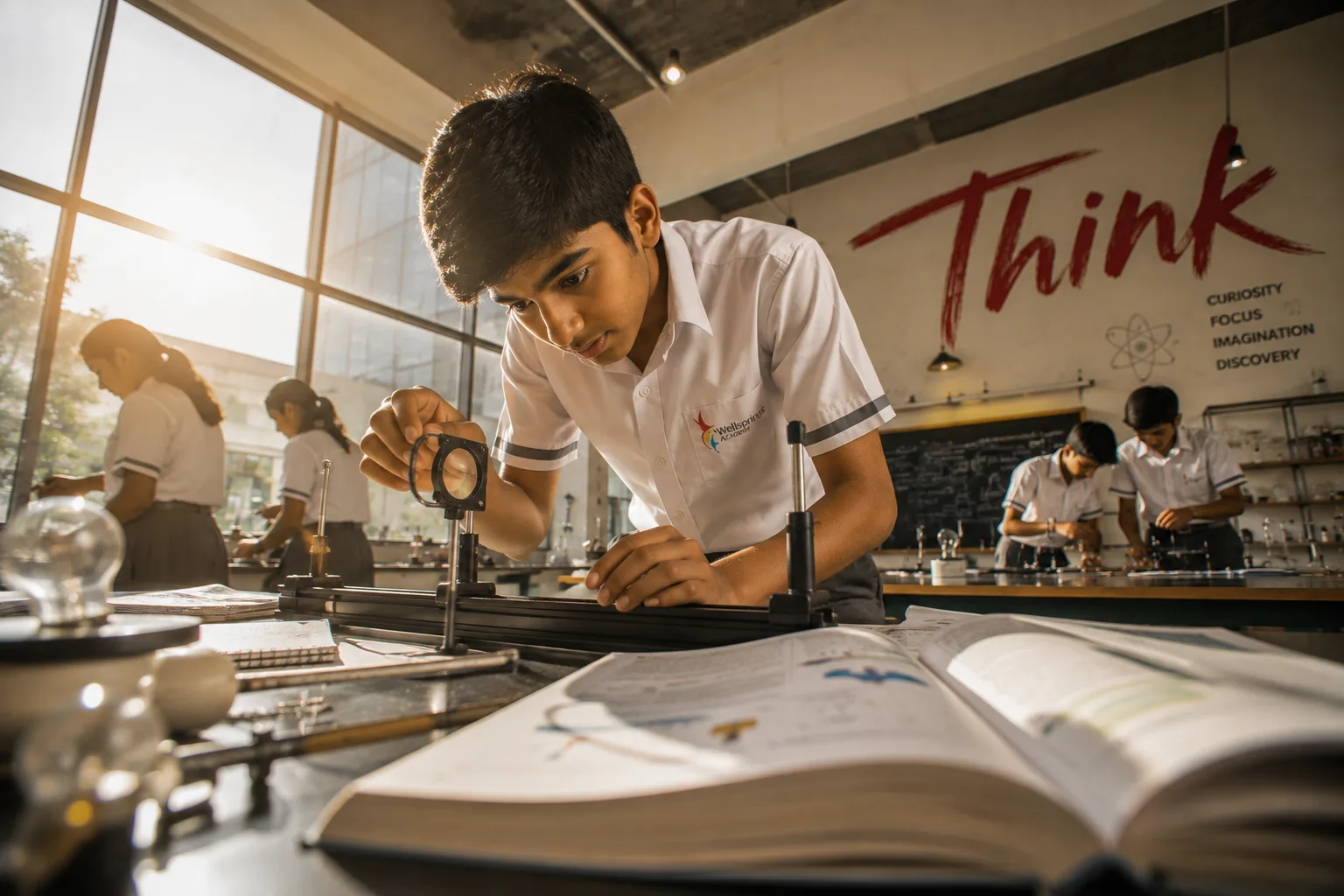
Secondary · Grades 9 to 12 · Ages 14 – 18
The years that ask
for focus.
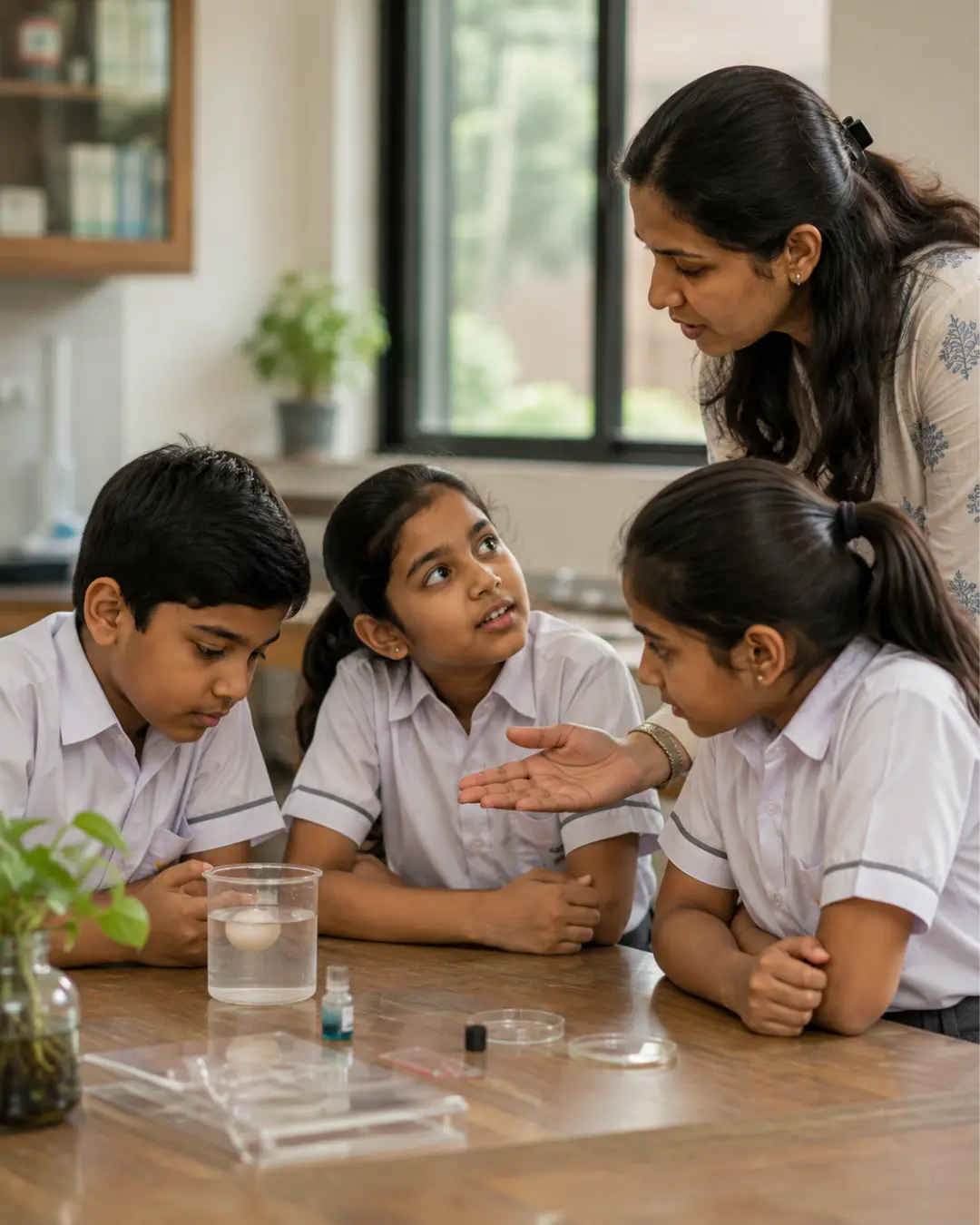
Grades 9 and 10 carry the weight of the board years. A class teacher, subject specialists and reinforcement teachers work together, with an hour of academic support every day after school.
Our promise to your child
Think·Build·Belong
01The stage at a glance
- Grades
- 9 – 12
- Ages
- 14 – 18
- Ratio
- 15:1
- Class size
- Up to 36
- In the room
- Class teacher, specialists and reinforcement teachers
- The day
- 8am – 3pm
- Week
- Monday – Saturday
- After school
- One hour of support, daily
02What these years build
Six things a child carries out of Secondary.
Answer writing
Lab discipline
Research and case studies
Presenting an argument
Working in a team
03Grades 9 and 10 · Academics
The CBSE syllabus, taught for understanding.
Subjects offered
English
Literature, comprehension and structured writing.
Mathematics
Standard or Basic, chosen with the family and the teacher.
Science
Physics, chemistry and biology, with full practicals.
Social Science
History, geography, civics and economics.
Second language
Chosen by the family.
Computers / IT
Digital skills carried through both years.
Skill subjects — chosen in Grade 9, carried through Grade 10
- 01
Information Technology
Applied digital work.
- 02
Artificial Intelligence
Data, logic and modern tools.
- 03
Computer Applications
Programming and problem solving.
One skill subject is chosen in Grade 9 and carried through Grade 10.
Laboratories
01Physics
02Chemistry
03Biology
04Computer Science
All four are used through the year, with practicals sitting alongside classroom teaching so experiments follow the concepts they belong to.
How we teach
- 01Competency-based
- 02Project-based
- 03Experiential
- 04Collaborative
- 05Case studies
- 06Peer learning
- 07Interdisciplinary work
- 08Real-life application
- 09Continuous feedback
04How progress is tracked
Five stages a year, and a monthly conversation.
- 1
Stage 1
Pre mid-term
- 2
Stage 2
Mid-term exam
- 3
Stage 3
Post mid-term
- 4
Stage 4
Preparatory exam
- 5
Stage 5
Final exam
You meet the teacher every month. Reports come at the end of each term in a grading format, Learning Journals carry written feedback after the pre and post mid-term assessments, and there is an orientation before the major examinations.
05Board preparation
Built into the timetable from the first term.
Assessment stages
Five through the year
Daily support
One hour after school
Saturdays
Revision and remedial on non-working Saturdays
Past papers
Previous CBSE papers, competency and case-study questions
Pre-boards
Sahodaya pre-boards, marked outside the school
Mock tests
For timing, accuracy and presentation
06Support and stretch
Children move at different speeds. The plan allows for it.
If a child needs more time
Reinforcement worksheets, chapter-wise revision material, an hour of support daily, and extra sessions on non-working Saturdays.
If a child races ahead
Olympiads in five subjects, plus extension tasks.
Every week, for everyone
Every class visits the library once a week.
07After Grade 10
Choosing a stream, with people who know the child.
Orientation sessions for students and parents explain the two streams available — Science and Commerce — along with what each asks for and where each leads.
Streams
Science and Commerce
Board
CBSE, through to Grade 12
Choice made
In Grade 10, with counselling
Who counsels
Leadership, coordinators and subject teachers
Alongside those sessions, children are counselled individually based on their performance, aptitude and interests. Parents are part of that conversation.
Grades 11 and 12
Opening as our children grow into them. Wellsprings adds a grade as its first cohorts move up, rather than before it can teach it well. Subjects and timetable will be published as they are confirmed.
- Streams
- Science and Commerce
- Board
- CBSE
- Opens
- As each cohort moves up
Sport, the arts, clubs, STEAM and field visits sit outside the syllabus and run through every stage — see what a child does beyond books.
Next step
See a board year up close.
Sit in on a practical, look at the revision plan, and meet the teachers who carry Grades 9 and 10.